.jpg)
For a growing number of Australians, renting is no longer a short-term compromise between life stages. It is a long-term housing choice, shaped by proximity to work, flexibility and access to amenity.
That shift is already well underway. According to analysis from REA Group, renting has increased across every age group since 2006, particularly among people in their 30s and 40s, reinforcing that this is no longer a transient phase, but a sustained way of living.
Yet the experience of renting has not evolved at the same pace as the people it serves.
What remains is a system largely built around fragmented ownership, inconsistent management and buildings that were never designed with renters in mind. Too often, the quality of the rental experience is determined not by the building itself, but by the structure behind it.
When ownership is divided, accountability becomes diluted. When management is reactive rather than embedded, service becomes inconsistent. And when design is approached through a sales lens rather than a living one, the experience rarely extends beyond the apartment itself.
Build-to-Rent introduces a fundamentally different model.
With a single owner and operator, and a long-term view over the asset, performance is measured over time rather than at the point of sale. That shift creates a clear incentive to invest in the quality of the living experience, not just the delivery of the building. Design, operations and service are considered together from the outset, rather than layered on after completion.
At Nation, that approach begins at the precinct level.
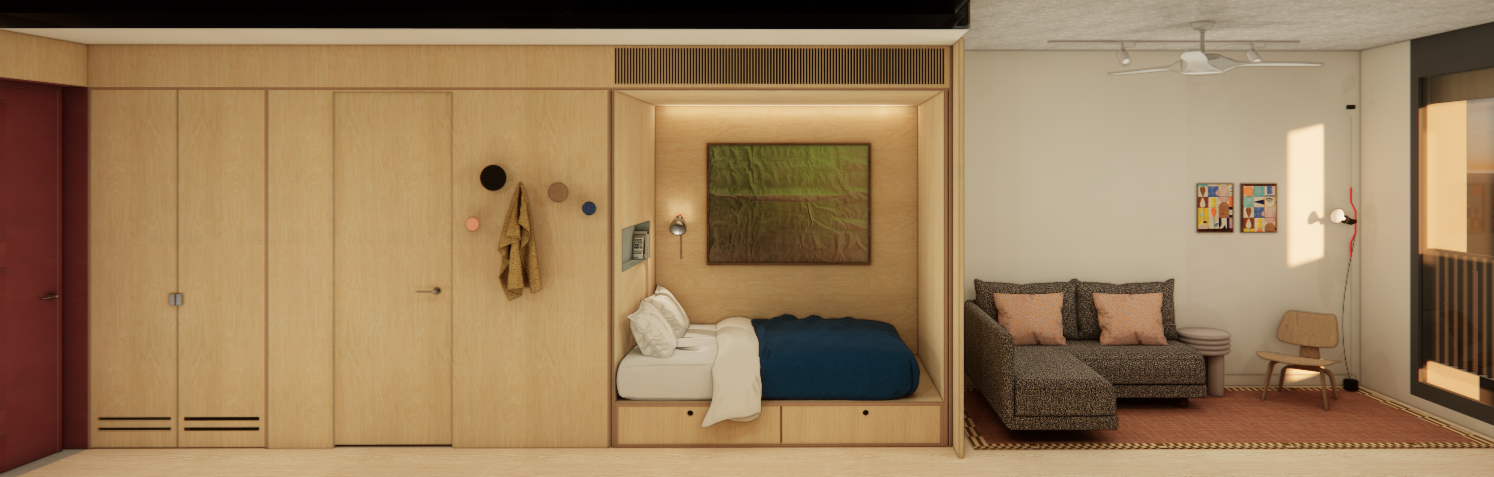
Our communities are conceived as connected, design-led environments, where architecture, interiors and public-facing spaces work together to support how people live day to day. This has been recognised through national and international interior design awards across Nation Merrylands and Nation Parramatta City, reflecting a consistent commitment to quality that extends beyond the apartment itself.
Within these precincts, the role of amenity is deliberate. Shared spaces are not treated as add-ons, but as an extension of the home, supporting work, wellbeing and social connection. In larger precincts such as Nation Merrylands, retail is integrated at ground level, bringing convenience and activation into everyday life and creating places that feel embedded within their neighbourhood rather than separate from it.
This is supported by a consistent, service-led approach to management, where responsive on-site teams, a strong focus on safety and the flexibility to adapt to residents’ needs over time all contribute to a more stable and considered living experience.
This foundation enables something more meaningful to emerge over time.
When ownership and operations are aligned, there is the ability to curate the living experience in a way that is both consistent and responsive. Programming becomes part of the rhythm of the community, from seasonal moments like Easter through to regular activities such as pickleball competitions and resident book clubs. These are not one-off activations, but part of an ongoing approach to creating places where people feel connected.
“Moving from a large family home into an apartment wasn’t something we ever thought we’d do, but what we found at Nation completely changed our perspective,” said Layale, a resident at Nation Merrylands.
“What stood out was that it wasn’t just about the apartment itself, but everything around it. The amenity, the shared spaces and the sense of community mean our home extends well beyond our front door. It really does feel like resort-style living, designed for everyday life.
“For our family of six, that’s made all the difference. The kids have space to play and connect with others, and we’ve been able to maintain the things that matter to us, like hosting family gatherings and spending time together. It’s a different way of living, but one that feels more connected, more convenient and ultimately more suited to how we live today.”
What this ultimately points to is a shift in how renting is understood.
When it is designed, delivered and operated as a long-term model, renting moves beyond transaction. It becomes stable, considered and service-led, offering a level of consistency that has historically been difficult to achieve.
The issue, then, is not renting itself. It is how renting has been structured.
And as expectations continue to evolve, so too will the standard for what it means to rent well.
Discover a different way to rent, one shaped by design, service and long-term thinking, enquire now.
The Daily Ritual
How the places we return to every day help make a neighbourhood feel like home. There’s something...